
Ask any language model for twenty ideas for a small business and you will get twenty ideas. Ask a hundred different people to do the same through the same model, and you will get roughly those same twenty ideas a hundred times over. This is not a complaint about model quality, and it is not the fault of a lazy prompt: it is a measured structural effect with a name, a literature and numbers behind it.
We spent the last few weeks on it up close. We pulled together the research on what is actually known about brainstorming with LLMs, built a working assistant on the AIFromSpace platform out of those findings, and spent three days running it blind against a single good prompt on Opus 5. What follows is the whole path — diagnosis, treatment, architecture, measurements. Including the measurements we lost.
The diagnosis: ideas collapse into the mode
The framing that spread through the industry: ideas from a raw AI brainstorm are bad in exactly the way stock photos are bad — technically correct, acceptable to everyone, and belonging to no one.
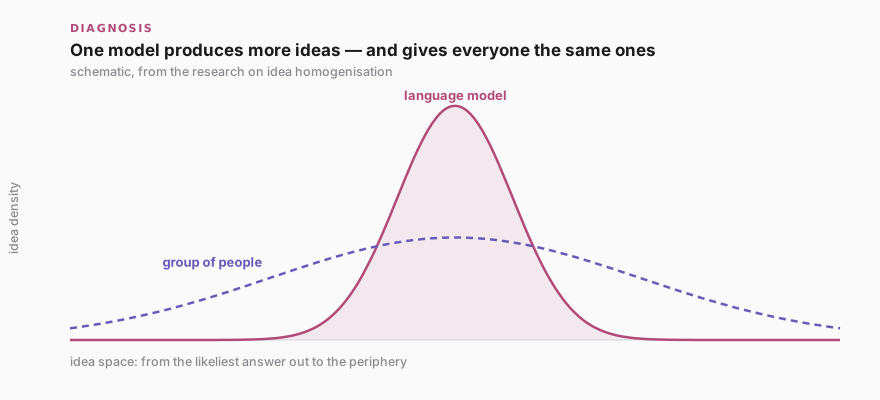
The key paper records a split between two levels. Each individual person paired with a model produces more ideas than they would alone. At the group level, diversity falls: the model offers similar things to different people. Individual creativity rises at the expense of the collective kind.
Four observations break the obvious ways around it.
Switching models does not help
Different models converge on similar solutions. The collapse is not in a particular vendor — it is in the way generation works.
Multi-agent setups do not save you
Agents couple structurally and collapse together. Running five generators is not enough; what matters is that they cannot see each other's work.
Prompting hits a ceiling
Sharper briefs raise the novelty of individual ideas, but the solutions stay inside the model's shared semantic space.
The result goes flat
There were fewer bad ideas — and fewer outstanding ones. The model lifts the middle and cuts off the tails.
That last point matters more than the rest, because it sets the goal.
The task is not to make the model better on average. The task is to get the tails back.
What actually works
The good news: techniques with a measured effect exist, and they are cheap. Below are the ones with a measurable gain in diversity in the literature, rather than a reasonable-sounding rationale. Roughly ordered by strength of effect.
| Technique | What it does | Effect |
|---|---|---|
| A "rewrite it bolder" pass | The model is told to rewrite its own ideas so they become bolder and as different from each other as possible | The largest diversity gain of anything tested — close to the level of a human group |
| Decoupling from a shared anchor | Parallel branches share no context and never see each other's output | Removes the clustering around whichever idea appeared first |
| Multi-persona prompting | Parallel prompts, each with its own professional lens | Pairs drawn from distant disciplines work far better than a set of adjacent specialists |
| Forced distant analogies | Take a mechanism from a deliberately foreign field and transplant it literally | A direct remedy for mode collapse; transplant the mechanism, not the mood |
| Morphological decomposition | Break the problem into parameters and options before generating | Reduces fixation: the model has no way to emit one single likeliest answer |
| Hard constraints | "Three people have to build this in four weeks" | The most repeated finding among practitioners: generic ideas grow out of generic briefs |
| Temperature | Moves diversity metrics | A blunt instrument: it does not leave the shared semantic space, and above roughly 1.2 it damages coherence |
A separate line of work covers how to divide labour between the human and the model, and it converges on three things. People who worked with a model in question mode (the model asks rather than answers) generate noticeably more diverse ideas and do not homogenise with each other. Divergence and convergence must be split into explicit phases with a visible boundary — mixing them triggers premature fixation. And leaning heavily on model output raises the human's own fixation, so it pays to generate your own ideas before you see the machine's.
How we assembled it
We folded all of the above into a single assistant on AIFromSpace. It is called the Idea Generator, and it runs on the same building blocks available to any author on the platform: several models in one scenario, parallel calls, tools, memory. There is no special magic under the hood — there is an architecture of three phases.
Intake
One volley of five to eight questions with importance markers — not a form that drips out one field at a time. It treats the root cause of generic ideas: an empty brief.
The rule against tedium: two rounds maximum, an always-available "just go" escape, and silence counts as an answer.
Salvo
Five lenses in parallel, each on its own model, and none of them sees the others' output. Independence, not the number of agents, is what keeps the ideas from collapsing.
Seeds for the analogy lens come from a real random number generator: "pick a random field" makes a model drift to the same narrow set of examples.
Synthesis
Merge duplicates, throw out the obvious, and rewrite the survivors in a bolder version — the step with the largest measured gain.
The output is a single numbered list, sorted from the grounded to the wild.
One more decision is counterintuitive: the lenses sit on different model families, not on four calls to one model. Four branches of the same model converge — that is precisely the effect NoveltyBench measures. Four branches from different families diverge far more honestly.
| Lens | Model | Temperature |
|---|---|---|
| Analogies | Kimi K2.5 | 1.0 |
| Inversion | GPT-5.6 Luna | 1.2 |
| Moonshots | DeepSeek V4 Flash | 1.15 |
| Morphology | GLM 5.3 Flash | 0.85 |
| Personas | Gemini 3.7 Flash | 1.0 |
All of that is pretty theory. Now the measurements.
Measurement one: Marina's bakery
We handed the same brief to two contenders and gave forty ideas to a blind judge — a separate instance of Opus that took no part in generation, did not know the authorship, and received every idea in one language and one format.
Opus 5, one prompt
Not a naive prompt: the role of a strategist, a ban on the obvious, a demand for range from cheap to wild, and an explicit instruction to use analogies, inversion and morphology — all of our techniques, inside a single head.
1 call · 66 seconds · 20 ideas
Our 5-lens salvo
Five model families, lenses blind to each other's output, analogy seeds off real dice.
35 raw ideas → 20 after synthesis
The brief was deliberately concrete: a small independent bakery in a residential district, owner Marina, revenue down 15% over six months, a chain coffee shop opened across the street, an experiments budget of 50,000 ₽ a month, a signature sourdough rye, and an owner who hates selling.
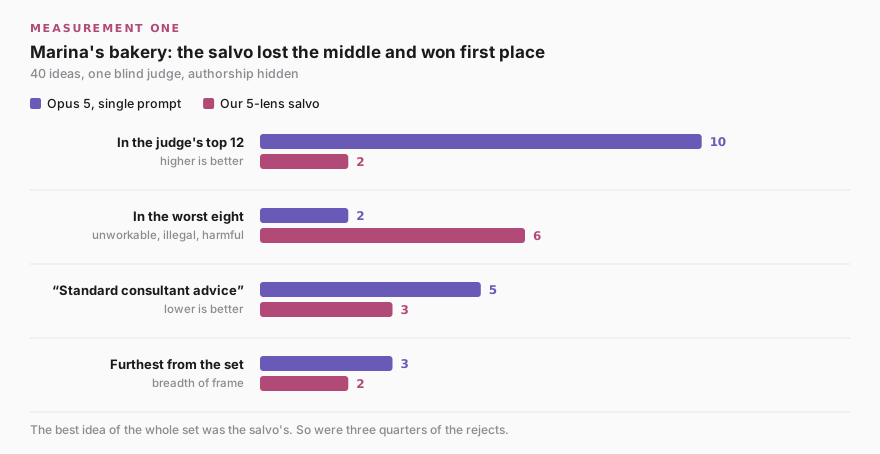
First place went to our idea: "bread at 6:30 pm, order by noon." It hits the bakery's structural problem exactly (two two-hour windows of foot traffic), turns dead hours into paid production, and removes the act of selling — Marina reads off a list. None of Opus's twenty ideas satisfied the judge that much.
Then comes the bill. Our contributions to the worst eight included drones dropping bread onto car roofs in traffic (illegal), a bread bank paying pensioners a lifetime daily ration (unlicensed deposit-taking), "stop selling the usual bread" (kills the one thing that works), and a lottery ticket baked inside the loaf (a foreign object in food). The moonshot lens honestly delivered 10x — 10x in the direction of a cliff.
What turned out to be more interesting than the score
Knowing nothing about authorship, the judge grouped the forty ideas into nine twin clusters. All nine were mixed: each held an Opus idea next to one of ours. Collect the bread where you live. Hold a loaf by list. Give away the mother starter. Make the grandmother the seller. The window as a medium. Someone else's shelves instead of your own counter. Sell the culture, not the loaf. The bakery as an evening event. Order ahead, collect in a batch.
Two different architectures, six different model families, decoupling from the anchor, dice for seeds — and both sides independently arrive at the same nine families of solutions. That is no longer one model's mode. It looks like the attractors of the problem itself: the solution space for a struggling neighbourhood bakery genuinely has a shape, and both systems found it.
Three things we took away from this round:
- Structure does not replace the model. Five cheap models in a clever frame produced roughly the same spread of themes as one frontier model in a single pass — but filtered common sense noticeably worse. What Opus calls an idea often turns out, in a cheap lens, to be a phrase that resembles one.
- Our product is the tail, not the median. We won first place and lost the middle. The value of a salvo is not that it is better on average, but that it occasionally reaches something a single pass cannot.
- Dropping evaluation was right, and it cost us. Six of the eight worst ideas were ours. A blind judge as a separate layer is not decoration — it is a seatbelt.
Measurement two: five rounds on a marketplace brief
Next we started editing the synthesis config and running round after round on a different brief — ideas for a marketplace of assistants. The frozen Opus answer stayed identical across every round; each round got a fresh blind judge. "Top 12" means how many of our ideas the judge placed in the best dozen out of forty.
| Round | What changed | Top 12 | Worst 8 | Winner |
|---|---|---|---|---|
| R1 | Grounded moonshots, judge inside synthesis | 3 : 9 | 8 : 0 | Opus |
| R2 | Cut only for breakage, fill gaps from the salvo | 5 : 7 | 4 : 4 | Opus |
| R3 | "Unfair advantage", precondition trap | 6 : 6 | 5 : 3 | Opus |
| R4 | Quota for the "boring middle" (a mistake) | 3 : 9 | 8 : 0 | ours |
| R5 | Quota rolled back to the R3 config | 4 : 8 | 6 : 2 | Opus |
There is one substantive conclusion here, and it is about prompts in general rather than about ideas.
Any wording that legitimises the ordinary is used by the model as a licence for the ordinary.
Both rounds where we failed outright carry the same signature — eight of the eight worst ideas were ours — and in both, the config contained a phrase permitting mass, boring pain points.
The by-product of this debugging turned out to be worth more than the score. Across five rounds, two independent systems and five different judges, three families of ideas surfaced consistently.
Checks before a deal
Price an item from a photo, vet the seller, scan a listing, re-check lots overnight. Both systems arrive here independently, in every round.
Translating officialese
Explain a letter from an agency, break down a utility bill. It only passes in the "what to ask" frame — a version that drafts the complaint is legal analysis.
The family archive
Restoring old photos, a grandmother's voice, a family chronicle. The judge praises them for retention every time — and groups them as duplicates of each other every time.
The judge also cut three things insistently and repeatedly: anything requiring an audience you already have; anything whose first value arrives after a week of accumulated data; and financial modelling with a disclaimer attached.
Measurement three: is the salvo needed at all
We knew the salvo held level with Opus. What we did not know was the thing that matters: whether the salvo is what does it — or whether a cheap model would produce the same in a single request for pennies.
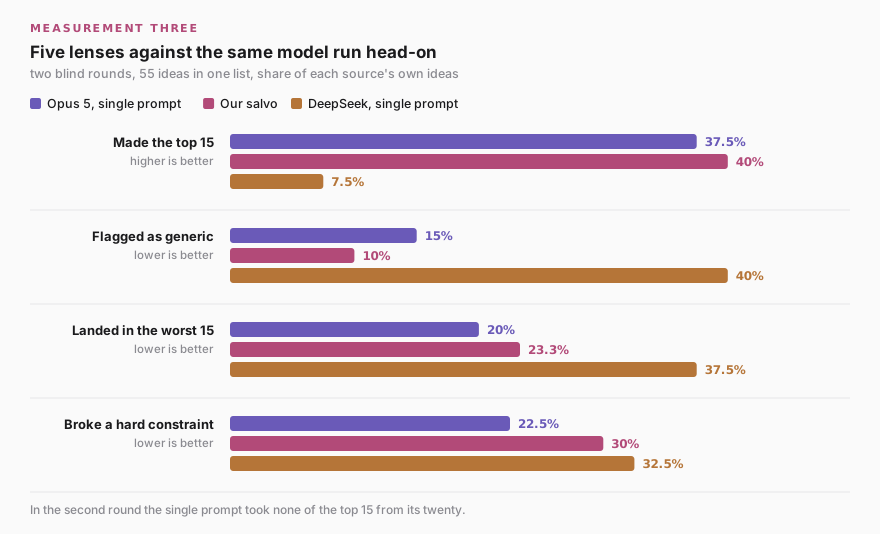
Next, all five models the salvo is built from were run on one identical prompt, each at its working temperature. A hundred ideas, one blind judge, parity at 4 of 20 per model.
| Model | Top 20 | Generic | Violations | Worst 20 |
|---|---|---|---|---|
| DeepSeek V4 Flash | 8 | 2 | 2 | 0 |
| GLM 5.3 Flash | 7 | 7 | 4 | 2 |
| GPT-5.6 Luna | 4 | 9 | 1 | 2 |
| Gemini 3.7 Flash | 1 | 5 | 12 | 2 |
| Kimi K2.5 | 0 | 0 | 15 | 14 |
Three things come out of that table. Our choice of orchestrator was confirmed independently: DeepSeek is the best of the five on all four axes at once — we picked it for price and speed, and it turned out to be the strongest single generator in the set as well. GLM has the highest ceiling and a disastrous middle: four of the top five places alongside seven "generic" marks out of twenty — exactly the profile it sits on the mechanical morphology lens for. And Kimi is unusable alone: zero in the top, fifteen violations out of twenty ideas. Yet zero marked generic — it is not boring, it writes things that cannot be built. Its role in the salvo is raw material for someone else's synthesis.
One question remained: does the best of the singles, GLM with its ceiling, catch the salvo? No. Next to Opus and next to the salvo it drops below parity on the top and picks up 40% generic against our 7%. GLM's ceiling turned out to be an artefact of weak company.
The economics
If the salvo holds level with Opus on penny models, the tempting conclusion is "we are ten times cheaper". It is wrong.
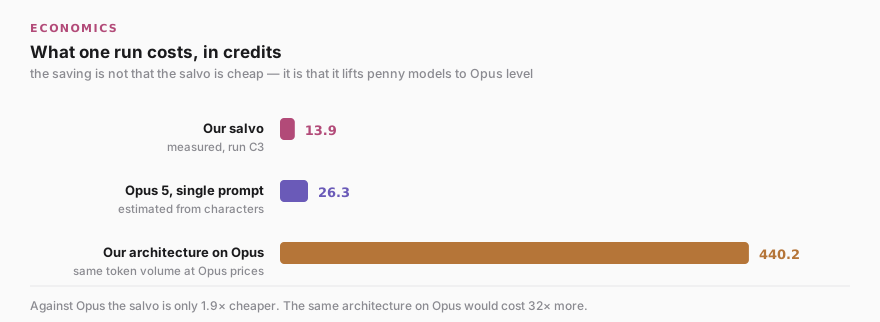
Against Opus we are only twice as cheap: 13.9 credits against 26.3. Per idea it is less still — 0.93 against 1.31, because Opus returns twenty ideas and we return fifteen. The reason is visible in the token breakdown: the salvo burns 57,000 input tokens against Opus's thousand, because the orchestrator re-reads a long system prompt, five lens outputs and a triage pass. We spend 22 times more tokens — they simply cost around a hundred times less, and that almost entirely eats the difference in model price.
The third row, though, is real. Running our own architecture on Opus would cost 440 credits — 32 times more.
The value of the salvo is not that it is cheap in itself, but that it lifts penny models to frontier level.
What these measurements do not prove
Honesty is cheaper than reputation, so here is the full list of holes.
- The judge is Opus, and one of the contenders is Opus too. Self-preference is possible, and it works against us: our draw with it is more likely understated than overstated.
- The Opus arm is frozen — the same set of ideas in every round. Those are not independent repeats; they are different judges looking at one text.
- One run per lens model. The ordering in the middle of the league is inside the noise; the gap between the extremes is not.
- Two briefs. A bakery and a marketplace. The proportions may differ in other domains.
- In the first round the ideas were interleaved strictly one by one — every even position was Opus. The judge was not told about authorship, but a perfect alternation of styles is a leak.
One correction to the research figures: some exact values and version names came from secondary sources. The qualitative picture reproduced across independent searches, but specific numbers are worth checking against the primary sources.
What we are fixing next
The one axis where the salvo is consistently not first is discipline about hard constraints, and the spread there is wide: between 1 and 8 violations across runs. That is instability in synthesis, not a ceiling of the architecture. The moonshot lens also needs grounding: drones over traffic and taking deposits from pensioners are not boldness, they are a loss of contact with reality. The cure is simple — a requirement that an idea stay legal and buildable by three people, written straight into the lens brief.
And before anything else gets edited: three runs of one config, to measure the spread. We have already tried editing on a sample size of one.
What to take from this
If you are building your own agent — with us or anywhere else — this part transfers directly.
- Do not ask for ideas against an empty brief. One short volley of questions before generation buys more than any prompt edit afterwards.
- Separate the phases. Divergence first, convergence second, with a visible boundary. Evaluation inside generation kills boldness on takeoff.
- Decouple parallel branches. If they can see each other they collapse, and no number of agents fixes that.
- Use different model families rather than several calls to one: that is where the diversity comes from.
- Ask for a second "rewrite it bolder and unlike the others" pass. The cheapest and most underrated step of everything measured.
- Judge with a separate instance that took no part in generation and does not know the authorship. Otherwise you get sycophancy instead of assessment.
All of it is ordinary platform capability: several models in one scenario, parallel calls, tools, memory. The Idea Generator lives in AIFromSpace as a normal assistant, and the same construction can be built for your own problem the same way any other agent is.
Sources
- Generative AI enhances individual creativity but reduces the collective diversity of novel content
- Creative Homogeneity Across LLMs
- Diversity Collapse in Multi-Agent LLM Systems
- Anchorless Diversification for Parallel LLM Ideation
- Multi-persona prompting strategies (Design Science)
- Unlocking LLM Creativity through Analogical Reasoning
- Reducing Design Fixation in Ideation by AI with the Morphological Analysis Method
- Exploration vs. Fixation — separating the phases
- Towards AI as Colleagues — multi-agent ideation
- NoveltyBench — measuring collapse across repeated samples
- lechmazur/divergent — a divergent thinking benchmark